Free PDF
Get the AI Search 2027 report as a PDF
The seven shifts, the key numbers and the readiness check on 8 visual pages. We email you the download link.
Watch: AI Search in 2027: 7 Shifts That Decide Who Gets Found (3:26). The key points of this guide, explained on video.
On this page
In 2024, the forecasts said Google was finished. Gartner predicted search engine volume would fall 25% by 2026.
It didn't. Google had its biggest search quarter ever in early 2026.
But something else happened, and few saw it coming this soon. In June 2026, bots started sending more page requests than people. Cloudflare's CEO had expected that in 2027. It arrived more than a year early.
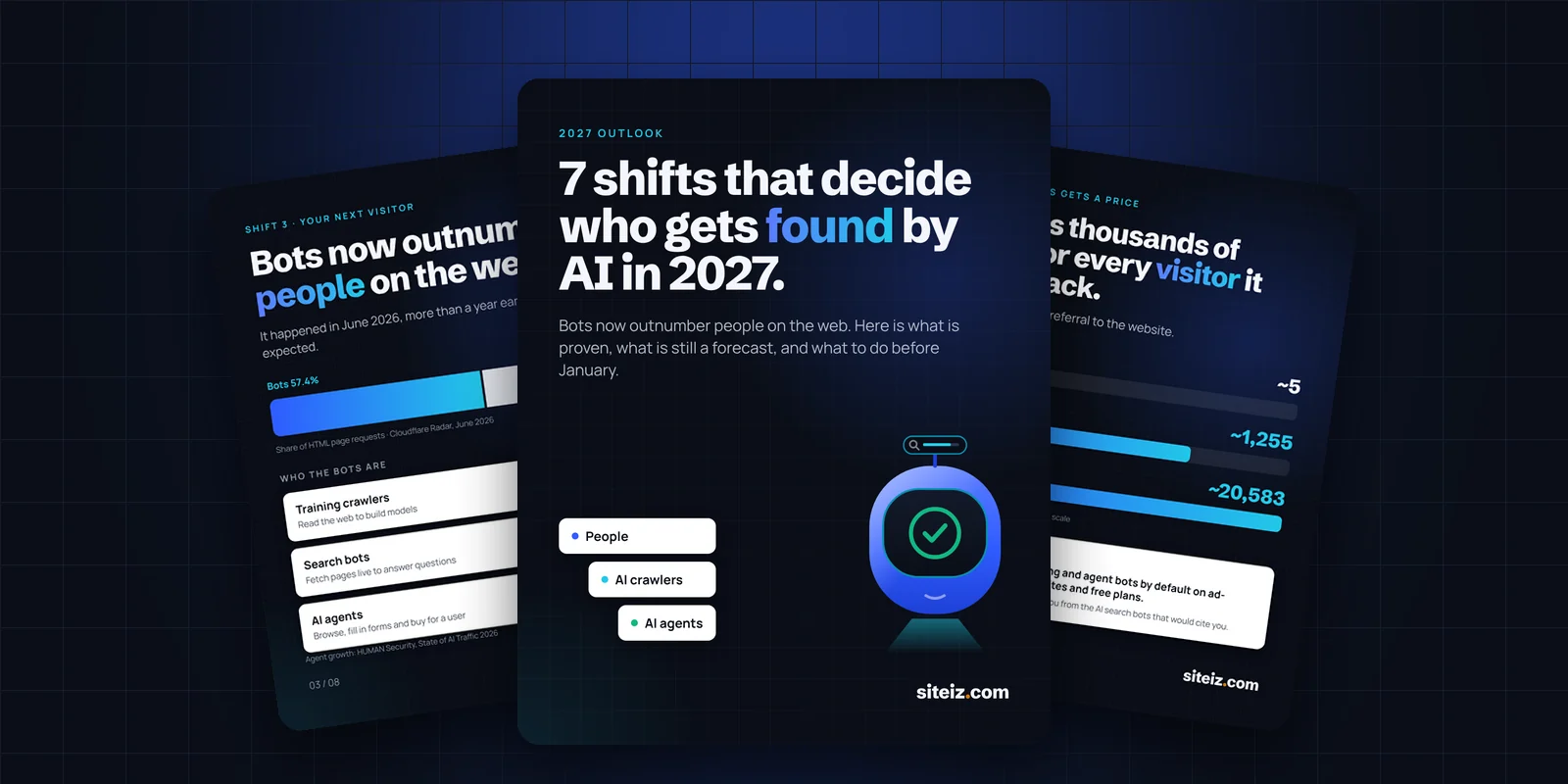
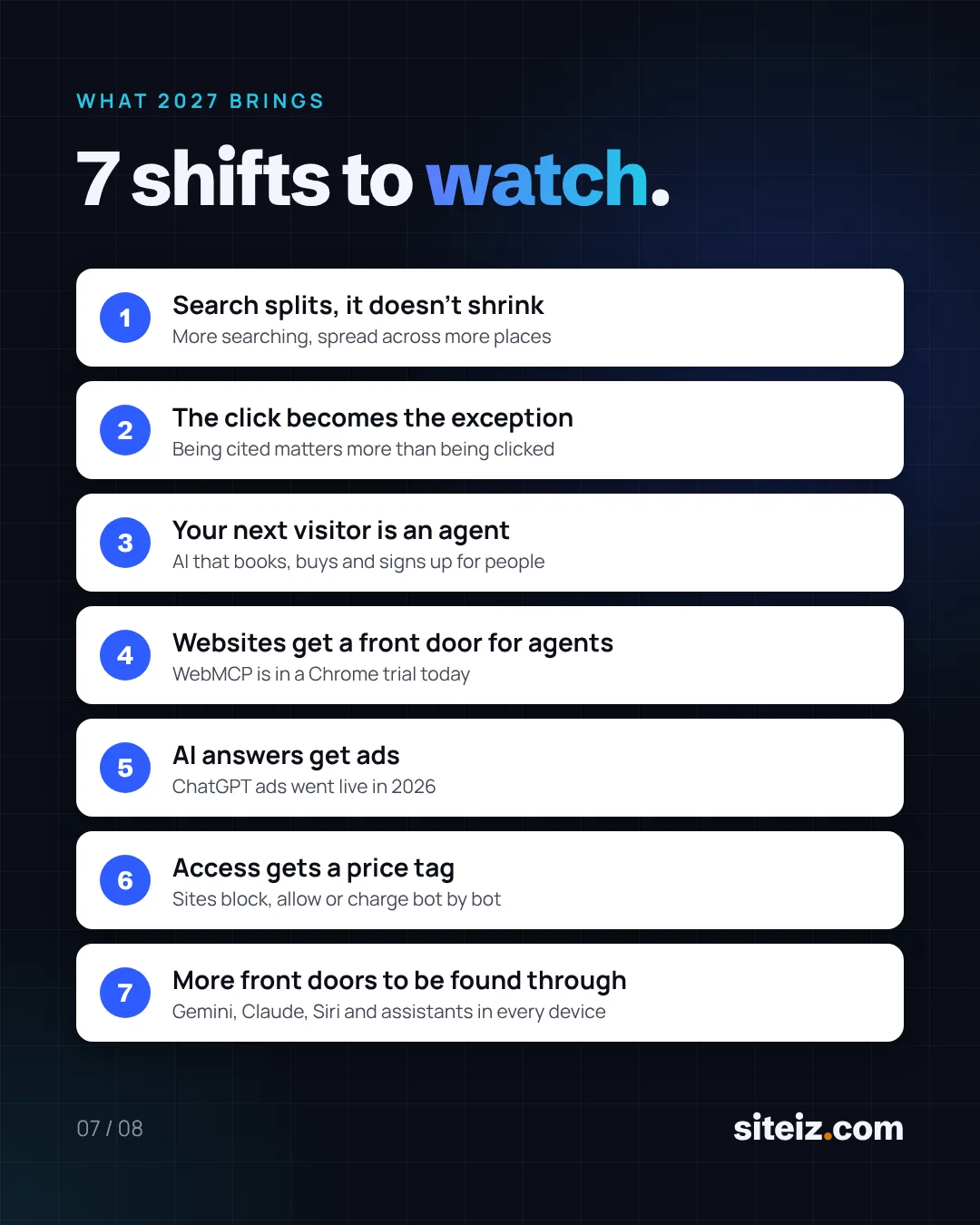
That is the real story of AI search: no engine has replaced another, but the web has a new kind of visitor. Below are the seven shifts to watch in 2027. For each one: what is already proven, what is still a forecast, and what to do. At the end are five questions every website should answer before the year turns.
2026 in 30 seconds
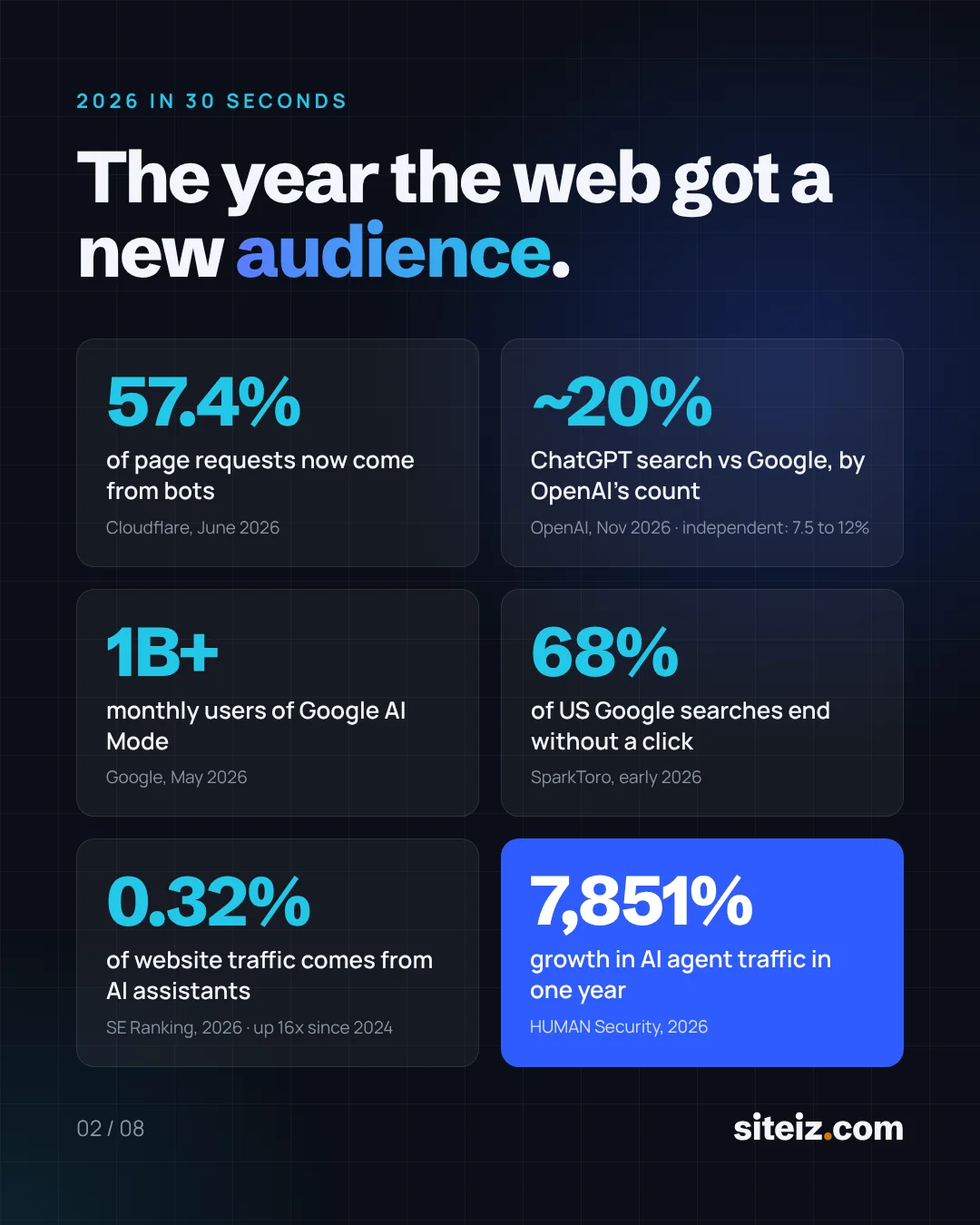
- 57.4% of HTML page requests now come from bots, not people (Cloudflare, June 2026).
- About 20%: ChatGPT's search volume compared with Google's, by OpenAI's count. Independent estimates say 7.5% to 12%.
- 1 billion+ people use Google's AI Mode every month (Google, May 2026).
- 68% of US Google searches ended without a click (SparkToro, early 2026).
- 0.32% of all website traffic comes from AI assistants (SE Ranking). That is 16 times more than in 2024, and still tiny.
Keep those numbers in mind. Every shift below grows out of them.
Shift 1: Search doesn't shrink. It splits.
What we know. Google did not lose its searchers. It added AI on top. AI Mode passed 1 billion monthly users within about a year of launch, and Google says total query volume hit an all-time high. Meanwhile ChatGPT grew to 1.2 billion weekly users and, by OpenAI's count, a fifth of Google's search volume. OpenAI has not published its method, and independent models put the figure lower.
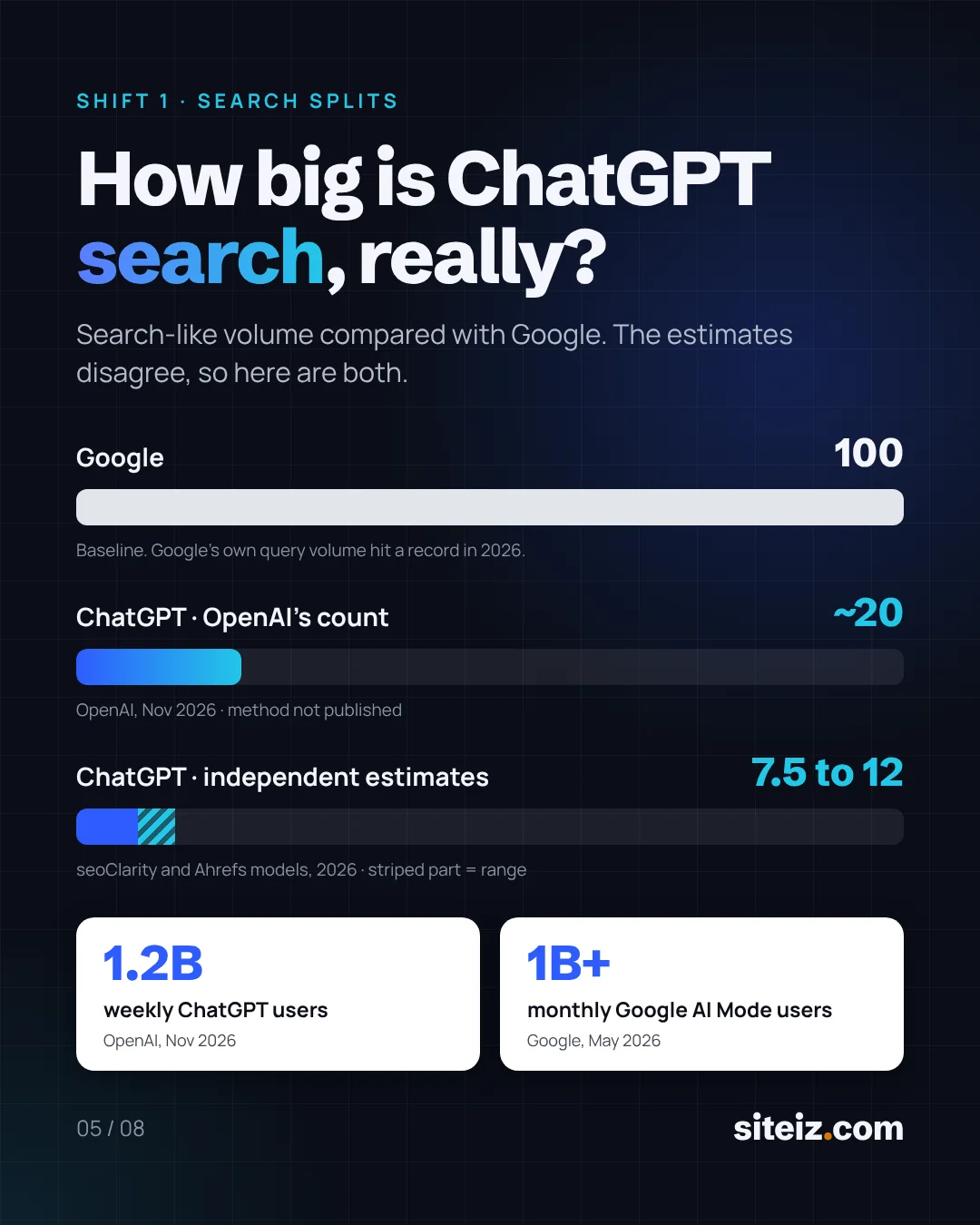
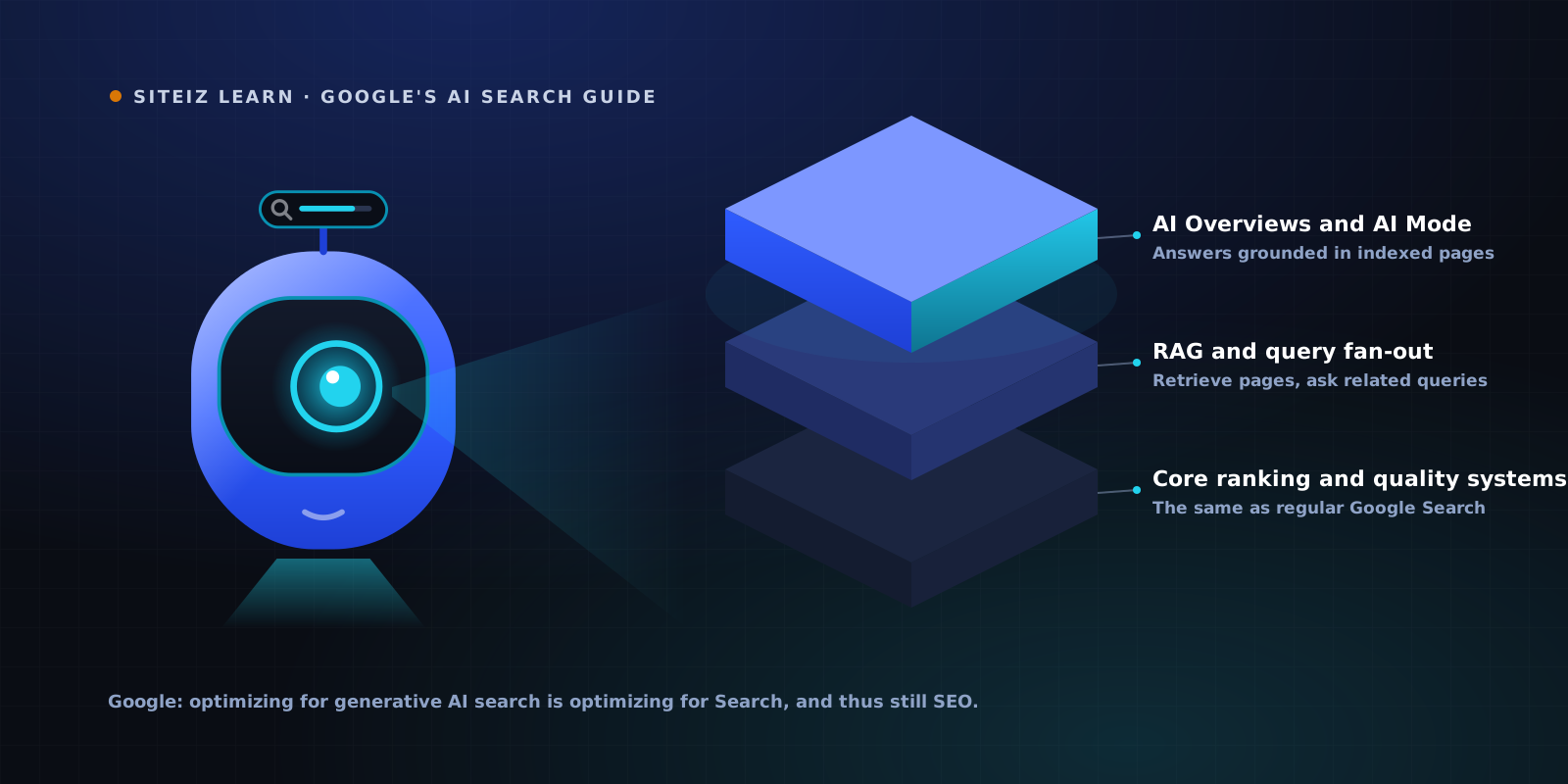
What 2027 brings. More searching than ever, spread across more places. Gartner still forecasts that organic search traffic to websites will fall by 50% or more by 2028. Note the difference: searches can grow while visits fall. For Google's own surfaces, the rules have not changed much. Google's AI search guide says optimizing for AI Overviews is still SEO.
What to do. Stop treating traffic as the only proof that search works. Track where you are seen, not just where you are clicked.
Shift 2: The click becomes the exception
What we know. Two out of three US Google searches already end without a click. On mobile it is closer to 77%. When an AI Overview appears, the top result loses about 58% of its clicks (Ahrefs). In AI Mode, about 93% of searches end without a visit (Semrush).
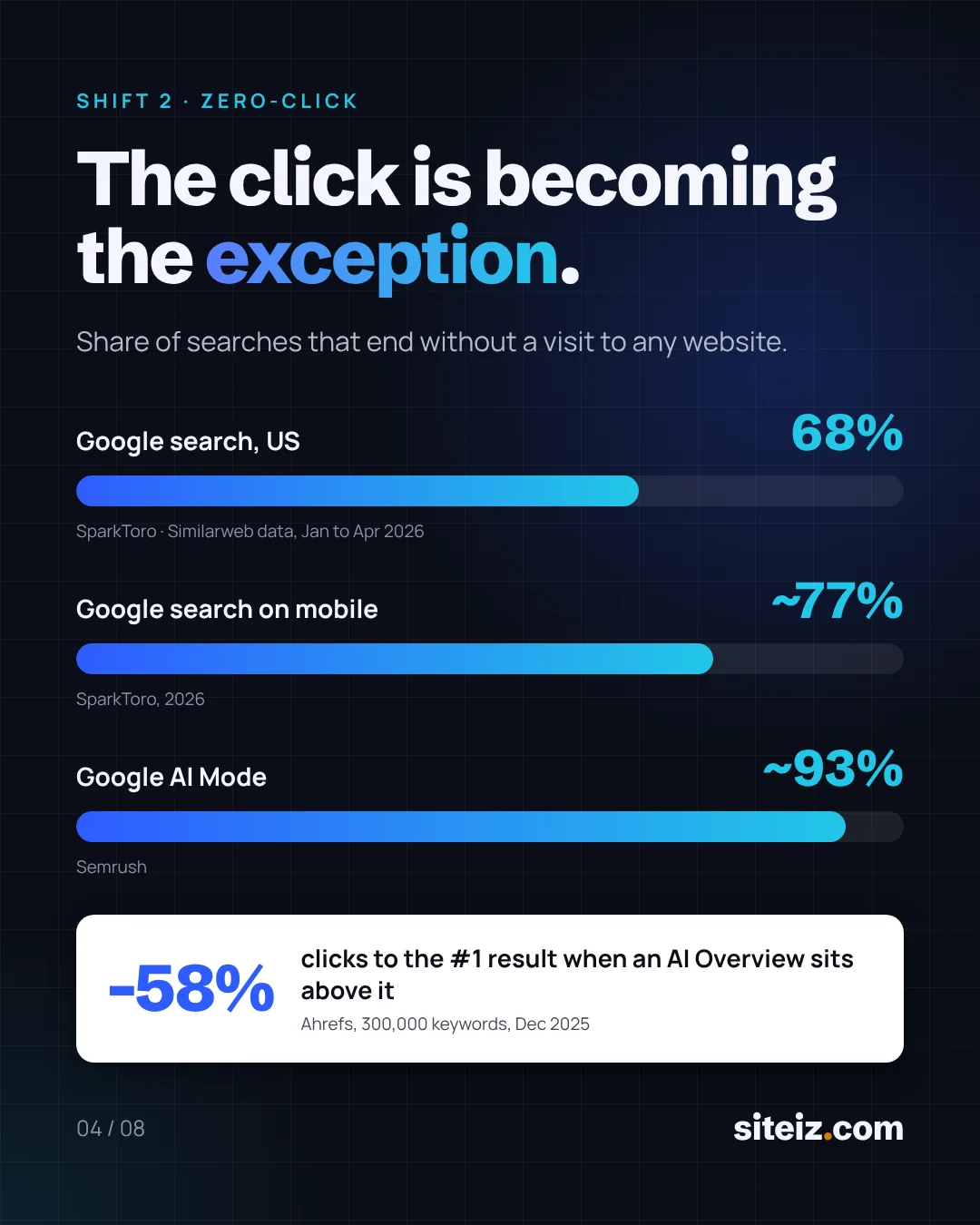
What 2027 brings. Forrester calls 2027 the start of the "post-click era" for digital commerce, where people shop through conversations and buyers delegate decisions to AI. The visits that remain will come from people who have already decided.
What to do. Aim to be the source the answer is built on. A citation with no click still shapes the decision.
Shift 3: Your next visitor is not a person
What we know. Bots passed humans on the web in June 2026. The fastest-growing group is agentic traffic: AI that browses, fills in forms and completes tasks for a user. HUMAN Security measured it growing 7,851% in a year. OpenAI's Atlas and Perplexity's Comet browsers send the most of it. DataDome logged over 600 million AI agent requests to login pages, carts and checkouts in the first half of 2026 alone.
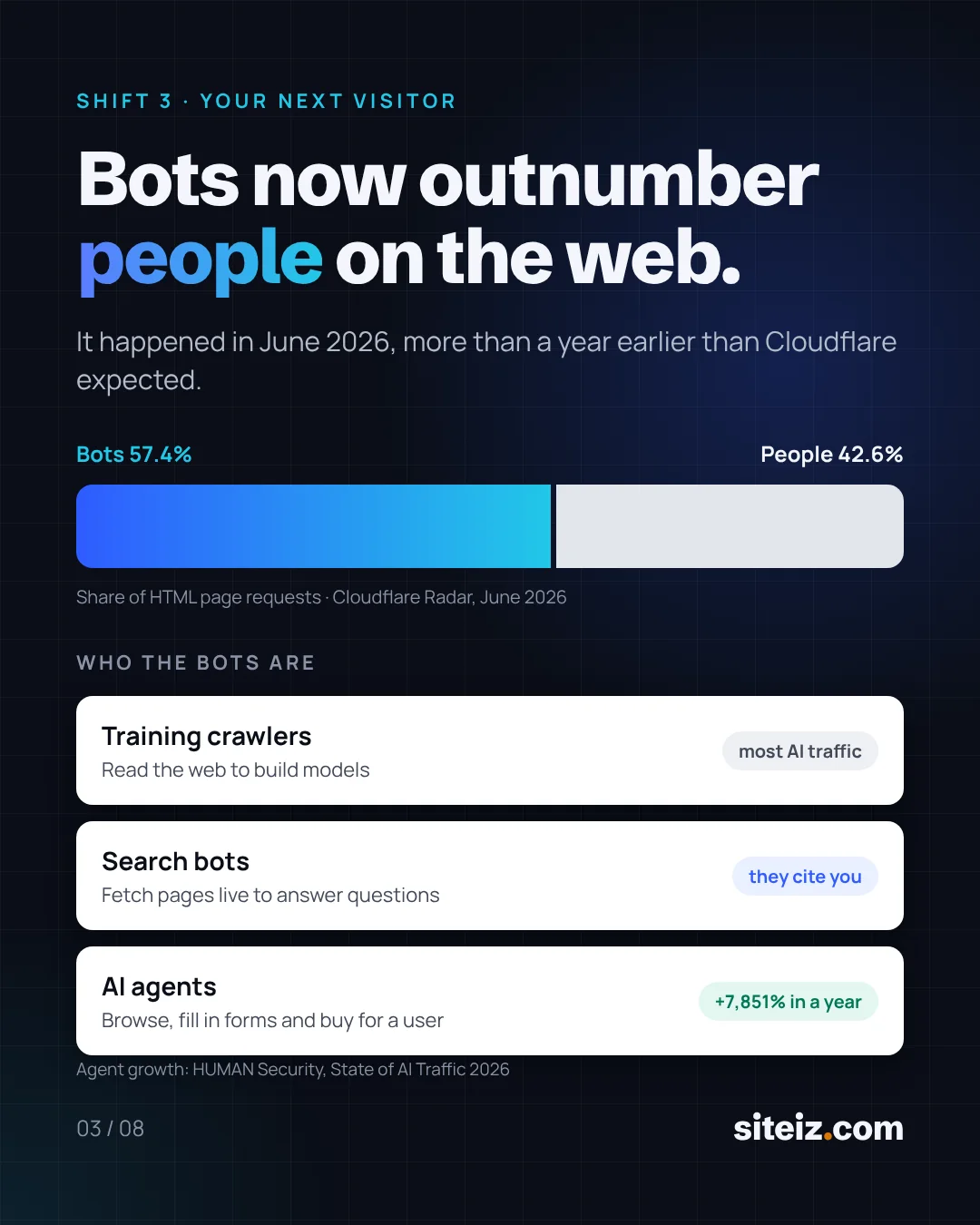
What 2027 brings. IDC expects agent use among the world's largest companies to grow 10x by 2027. In one enterprise survey, more than 90% of leaders expect AI agents to influence at least a fifth of online orders by then. Morgan Stanley sees agent shoppers reaching 10% to 20% of US e-commerce by 2030.
What to do. Test whether an agent can actually finish your most important task: book, buy, sign up or request a quote.
Shift 4: Websites get a front door for agents
What we know. Today, agents use websites by guessing: reading pixels and clicking buttons. At I/O 2026, Google and Microsoft proposed WebMCP, a way for a site to tell agents exactly which actions it offers, such as "book a table" or "submit a request". It is in a Chrome origin trial. It is not yet an official web standard.
What 2027 brings. Our call: WebMCP or something like it moves from experiment to expectation, starting with e-commerce and booking sites. Sites that agents can use reliably will get chosen more often.
What to do. You don't need WebMCP yet. You do need clean forms, clear labels and accurate structured data, because that is what any agent standard will build on.
Shift 5: AI answers get ads
What we know. ChatGPT started showing sponsored placements to free users in the US in February 2026 and opened self-serve buying in May. OpenAI says ads do not change its answers.
What 2027 brings. Our call: paid placements spread to more AI assistants and more countries. Organic AI visibility gets competition, the same way organic search did when Google added ads.
What to do. Build organic AI visibility now, while it is cheaper than buying it later.
Shift 6: Access gets a price tag
What we know. The old deal of the web was simple: let a search engine crawl you, and it sends visitors back. Google crawls about 5 pages per visitor it refers. In Q1 2026, Cloudflare measured OpenAI at about 1,255 pages per referral and Anthropic at about 20,583. Training crawlers send nothing back by design.
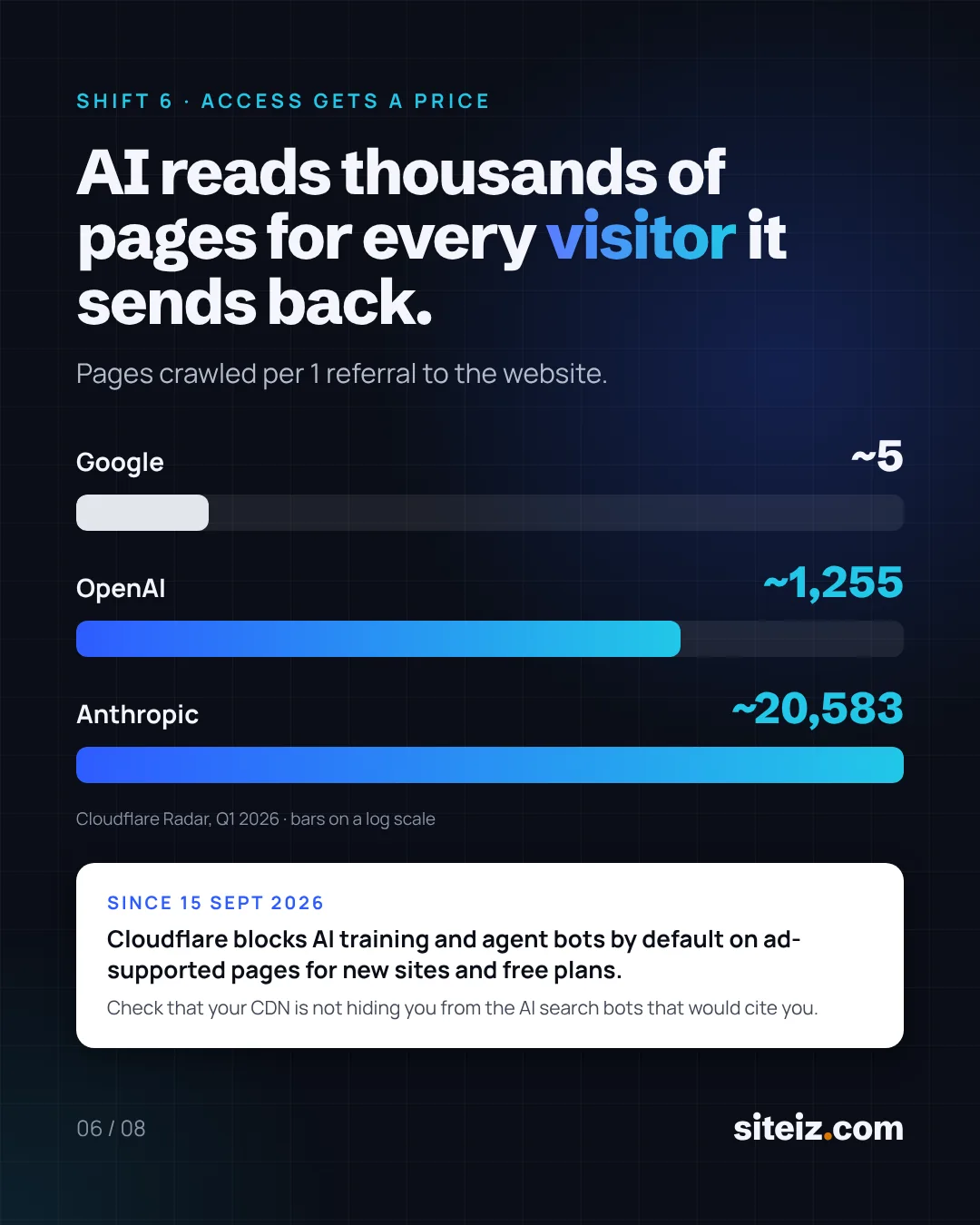
Publishers are pushing back. Since September 15, 2026, Cloudflare blocks AI training and agent bots by default on ad-supported pages for new sites and free plans, while still allowing search. Its Pay Per Use model pays publishers when their content shapes an AI answer.
What 2027 brings. More sites will decide bot by bot who gets in. Some will charge. Some will block by accident.
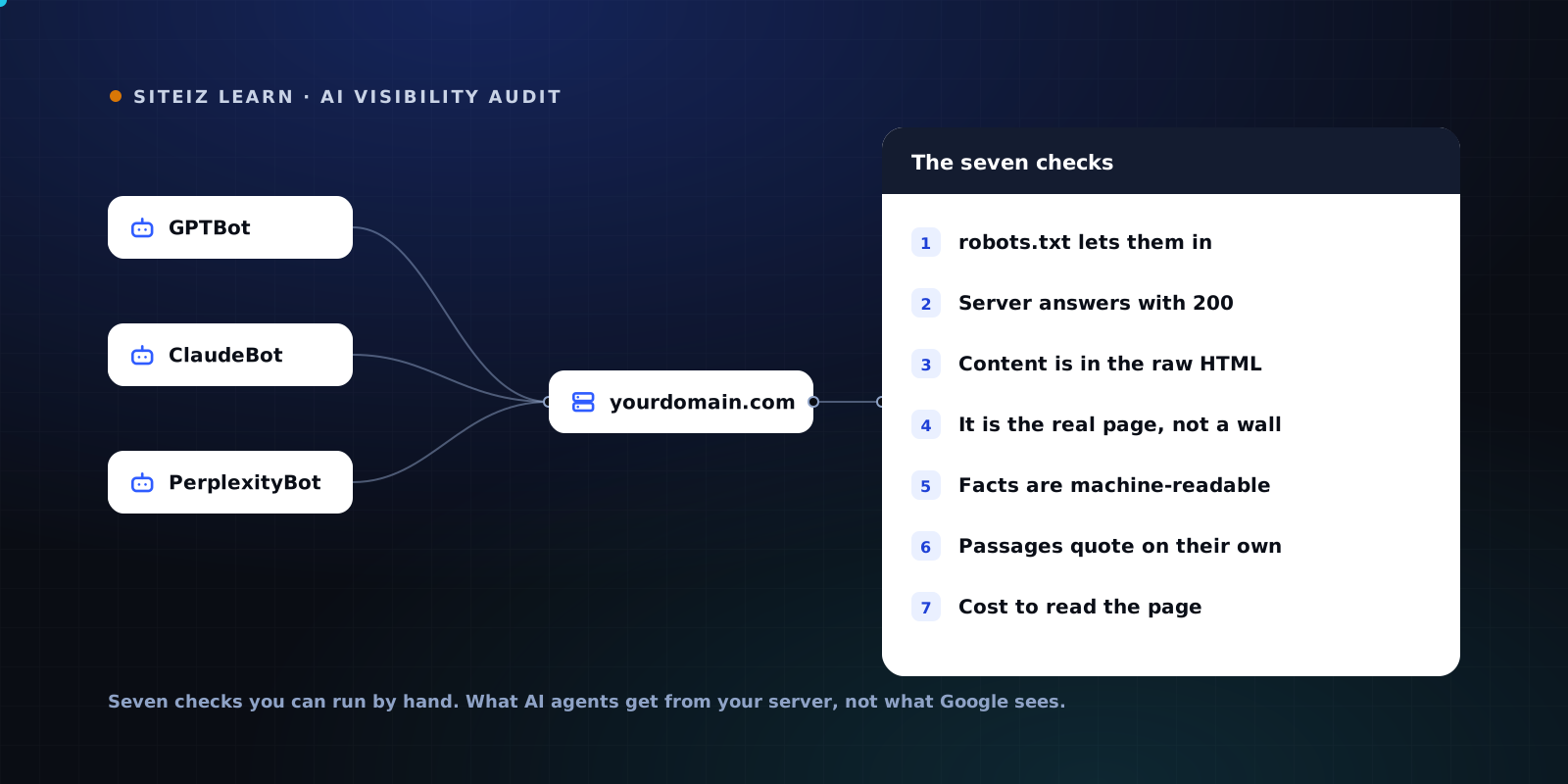
What to do. Check what your CDN and robots.txt actually allow. A default setting you never chose may be hiding you from the AI search bots that would cite you. Our AI visibility audit guide walks through the checks with curl.
Shift 7: More places to be found
What we know. Google's AI Overviews reach more than 2.5 billion people a month. Gemini overtook Perplexity as the second-biggest AI source of website visits. Claude is the fastest-growing, up more than 300% in a year (SE Ranking). Apple announced a new Gemini-powered Siri with iOS 27, though not yet in the EU.
What 2027 brings. No single winner. Assistants built into phones, browsers and operating systems become search engines in their own right.
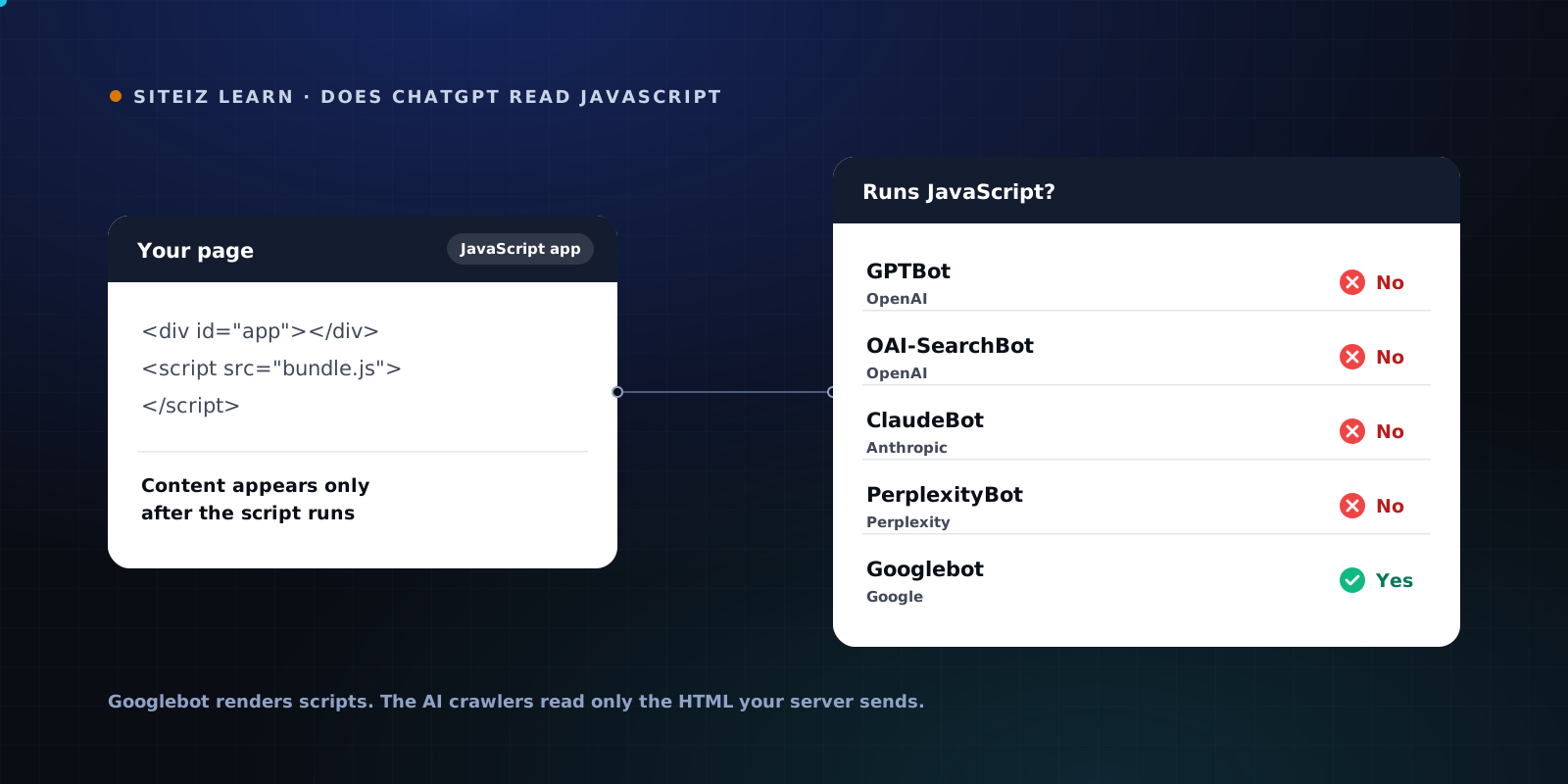
What to do. Don't optimize for one engine. Make your site readable for all of them. That starts with the basics they share: crawler access and content in the raw HTML, because ChatGPT's crawlers do not run JavaScript.
What the forecasts keep getting wrong
Predictions about AI search tend to miss in the same way. They expect one thing to replace another. Gartner's 25% drop never came, because Google added AI instead of losing users to it. Cloudflare's 2027 crossover came early because agents grew faster than anyone modeled.
The pattern: the web doesn't swap audiences, it adds them. People still search. Machines now search too, at far greater volume. The sites that win in 2027 will serve both.
The 2027 readiness check
Five questions to answer before 2027:
- Can AI bots reach you? Check robots.txt and your CDN settings for each AI search bot, not just Googlebot.
- Is your content in the raw HTML? Most AI crawlers don't run JavaScript. If your text loads by script, they see an empty page.
- Can an agent finish your main task? Use an AI browser to book, buy or contact you, and see if it gets to the end.
- Are your facts machine-readable? Put prices, opening hours, products and services in accurate structured data.
- Do you know where AI mentions you? Ask ChatGPT, Gemini and Perplexity the questions your customers ask. Note who they recommend.
About the numbers
AI search is new and hard to measure. The figures here come from company statements, clickstream panels, server logs and CDN data, and they do not always agree. Where estimates differ, we show the range. Company figures, such as OpenAI's 20%, are not independently verified. Anything marked "our call" is our forecast, not a measured fact. Our own scan works the same way: it measures what crawlers receive from your server, and the scoring method is public.
Sources
- OpenAI's Adam Fry on ChatGPT search volume and users (Big Technology, Nov 2026)
- ChatGPT search hits 20% of Google's query volume, with independent estimates (Forbes, Nov 2026)
- Gartner's search traffic predictions (Search Engine Land)
- Google AI Mode passes 1 billion monthly users (I/O 2026 coverage)
- Bot web traffic has overtaken human web traffic (NBC News, Jun 2026)
- HUMAN Security State of AI Traffic report (CNBC, Mar 2026)
- State of Bot & Agent Security Report 2026 (DataDome)
- Google zero-click searches hit 68% in early 2026 (Search Engine Land)
- AI Overviews reduce clicks, December 2025 update (Ahrefs)
- Predictions 2027: Digital Commerce enters its post-click era (Forrester)
- IDC study on agentic commerce (WooCommerce)
- AI agents tipped to reshape enterprise e-commerce by 2027 (IT Brief)
- Here come the shopping bots (Morgan Stanley)
- Google proposes WebMCP for browser AI agents (AI Weekly)
- ChatGPT ads in 2026 (Segwise)
- Cloudflare's new policy pushes AI companies to pay for content (TechCrunch, Jul 2026)
- Which AI crawlers get blocked most, Cloudflare Radar Q1 2026 (TechnologyChecker)
- AI traffic grew 16x from 2024 to 2026 (SE Ranking)
- Apple unveils Gemini-powered Siri and iOS 27 (Let's Data Science)
Free PDF
Get the AI Search 2027 report as a PDF
The seven shifts, the key numbers and the readiness check on 8 visual pages. We email you the download link.
FAQ
Common questions
Short answers to what people ask most about this topic.
Will AI search replace Google in 2027?
The data says no. Google added AI Overviews and AI Mode on top of Search and reported record query volume in 2026. ChatGPT grew alongside it, to roughly a fifth of Google's search-like volume by OpenAI's own count and 7.5% to 12% by independent estimates. Search is splitting across more places, not moving from one to another.
Is more than half of web traffic now bots?
For HTML page requests, yes. Cloudflare measured bots at 57.4% of HTML page requests in June 2026, more than a year earlier than its CEO had predicted. AI agents that browse and act for a user are the fastest-growing group.
How do I prepare my website for AI search in 2027?
Start with the two things every AI search engine shares. Make sure robots.txt and your CDN let AI search bots in, and make sure your main content is in the raw HTML, because most AI crawlers do not run JavaScript. Then check that an AI agent can finish your main task, that prices and services are in accurate structured data, and which sites AI assistants recommend for your customers' questions.
Is Cloudflare blocking AI crawlers on my site?
It may be. Since September 15, 2026, Cloudflare blocks AI training and agent bots by default on ad-supported pages for new sites and free plans, while still allowing search bots. Check your CDN bot settings and your robots.txt for each AI bot by name.