Free PDF
Get the full AI 100 study as a PDF
All findings, the charts and the results for every company on the list. We email you the download link.
On this page
On 12 November 2026, Bessemer Venture Partners and Newcomer published the AI 100: the 100 private companies they rank as defining the age of AI. Anthropic is number one, then OpenAI, Databricks and Stripe.
These companies build the crawlers, the models and the agents. So we asked a simple question: when an AI crawler visits their homepages, what does it actually get?
On 20 November we scanned all 100 homepages with the Siteiz scanner. Each one was fetched the way most AI crawlers fetch a page (plain HTTP, no JavaScript) and the way a person sees it (a real browser). We checked robots.txt for 11 AI crawlers, tested what the server returns to GPTBot, ClaudeBot and PerplexityBot, and looked for llms.txt, markdown and structured data.
The short answer: most of them are easy for AI to read. But one in eight showed our crawler a challenge page instead of the homepage, and the reason was the firewall, not robots.txt.
The results in 30 seconds
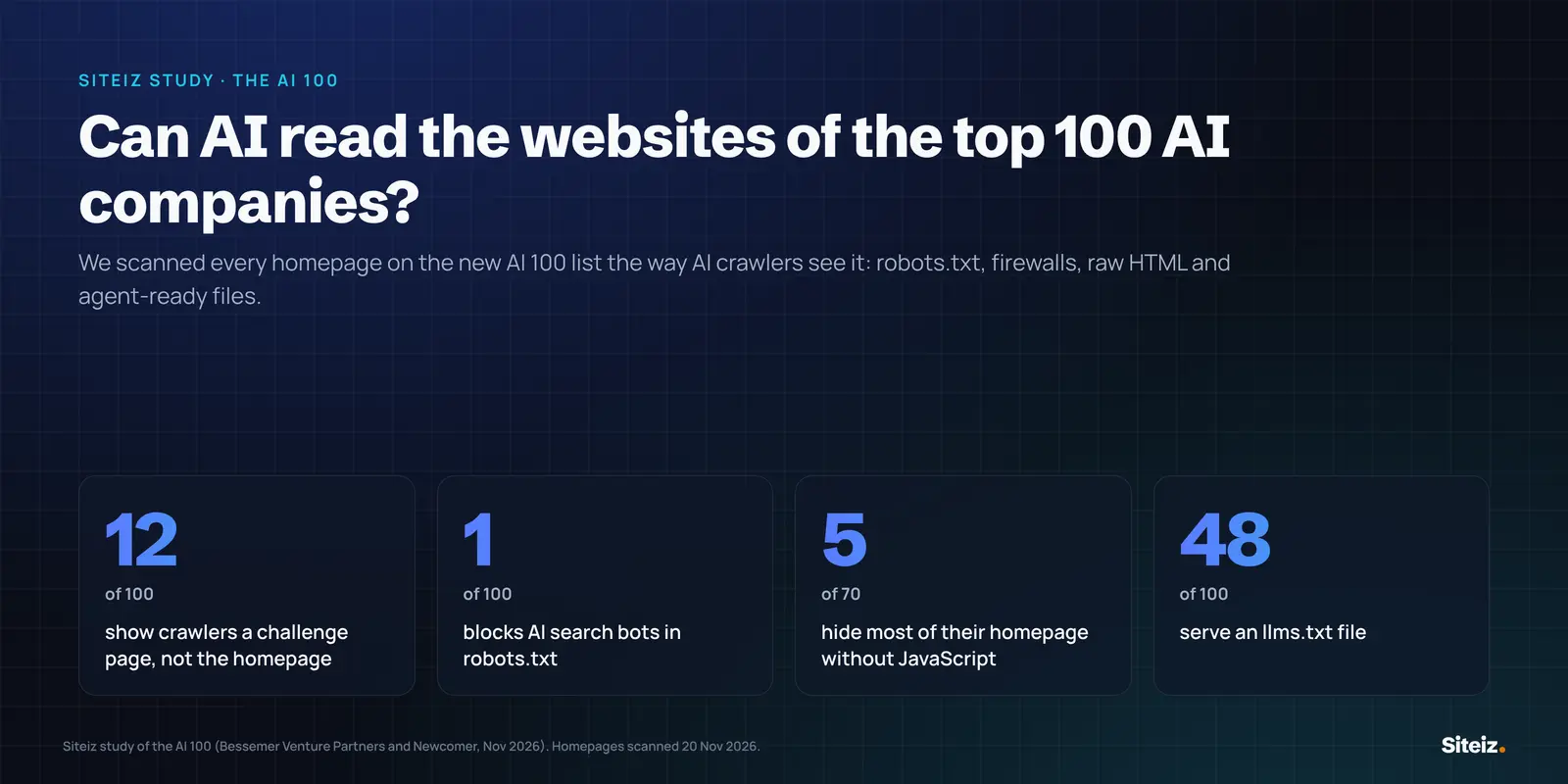
- 12 of 100 homepages served a bot challenge or CAPTCHA instead of the content, in two separate scans.
- 1 of 100 blocks AI search crawlers in robots.txt. 7 of 100 block AI training crawlers.
- 5 of 70 fully scanned homepages hide most of their text from crawlers that don't run JavaScript.
- 48 of 100 serve an llms.txt file. 21 of 100 serve markdown when an agent asks for it.
- The median Siteiz score was 82 out of 100 across the 70 homepages we could fully scan.
Finding 1: the firewall decides, not robots.txt
robots.txt is where a website says which crawlers are welcome. On the AI 100, it says yes to almost everyone.
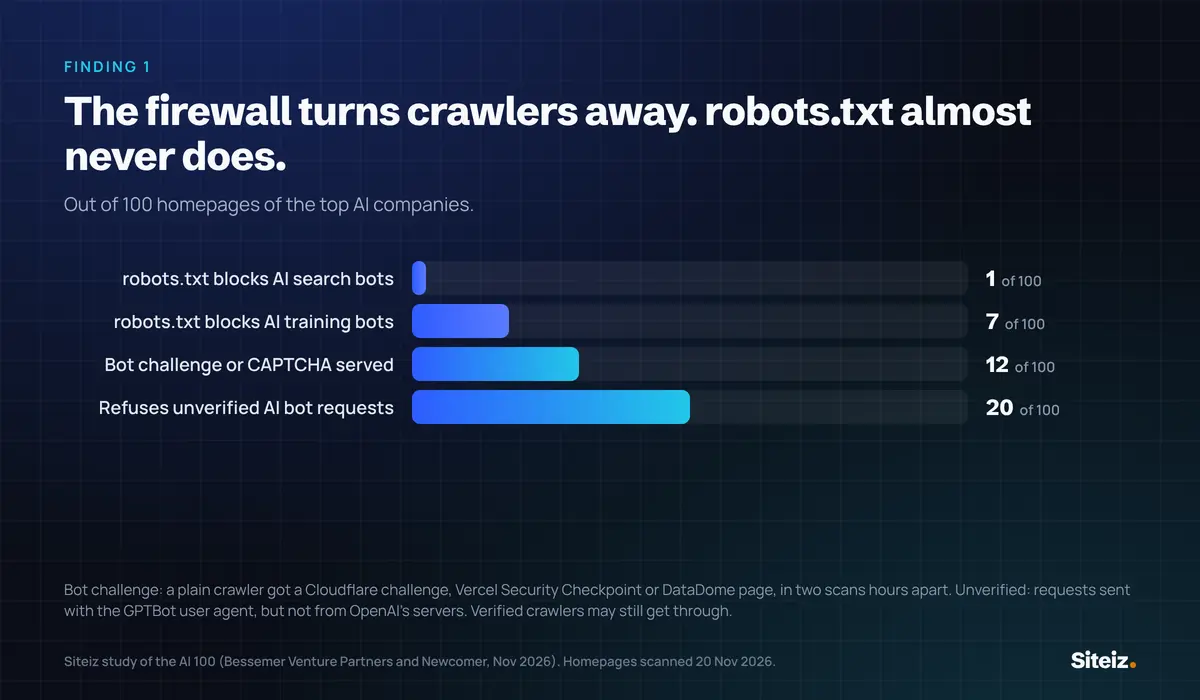
The firewall tells a different story. 12 homepages answered our crawler with a challenge page: seven with a Cloudflare challenge, four with a Vercel Security Checkpoint (HTTP 429) and one with a DataDome page. We scanned them again hours later, with longer pauses between sites, and got the same result each time.
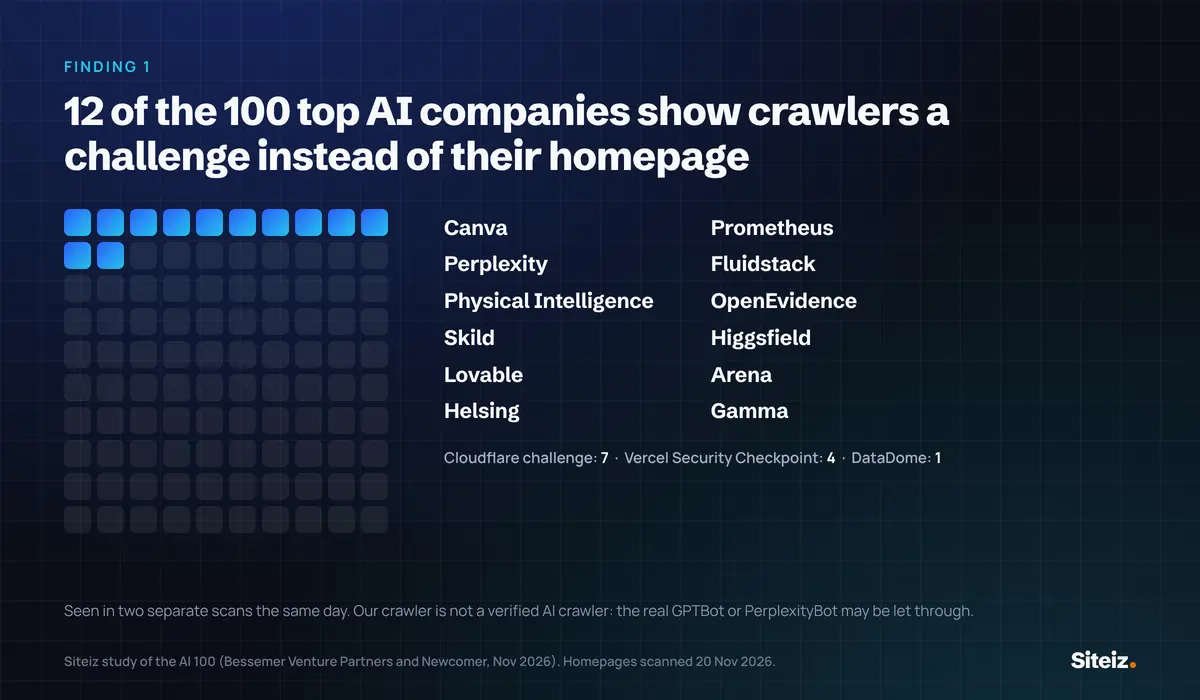
The list includes Perplexity, a company whose product is an AI search engine that reads other people's websites.
A second test points the same way. We requested each homepage with the published user agents of GPTBot, ClaudeBot and PerplexityBot, sent from our own servers. 20 of 100 refused those requests, most with HTTP 403. OpenAI was one of them: its homepage turned away a request that claimed to be GPTBot but did not come from OpenAI.
That is not necessarily a bad thing. Firewalls can check that a crawler really comes from the company it names, and refuse fakes. The real GPTBot, from OpenAI's published IP ranges, may well get in. So read this finding carefully:
- What it shows: on 12 of these homepages, a crawler without verified credentials gets a challenge, not content. Only crawlers the firewall knows and trusts get through.
- What it does not show: that ChatGPT, Claude or Perplexity cannot read these sites. We can't test from their servers.
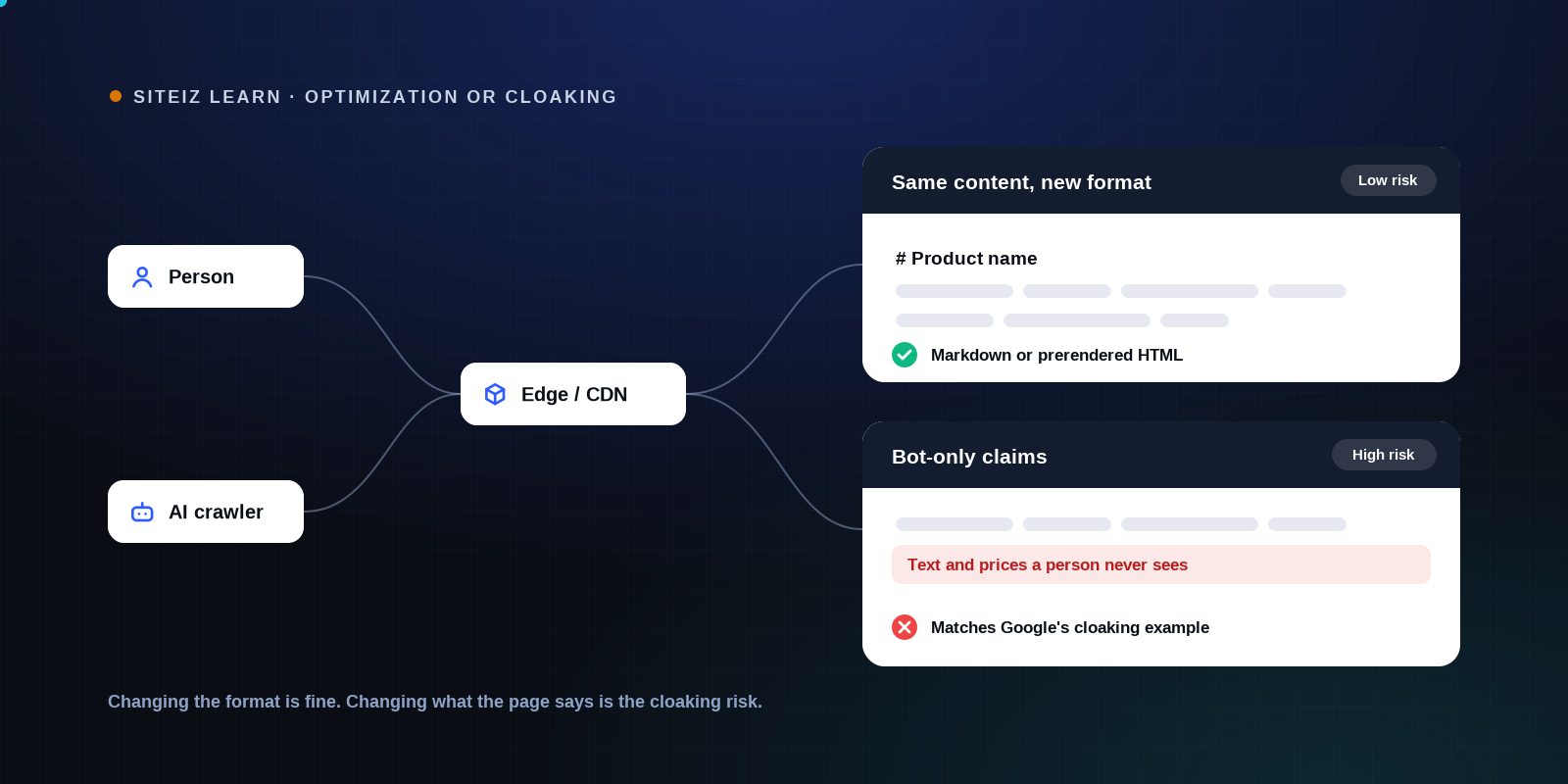
For your own site, the lesson is practical. Your robots.txt can welcome every AI crawler while your CDN or bot protection quietly turns some of them away. You only see the second one in your server logs or with a test that fetches the page as each bot. We wrote more about this in serving different content to AI bots.
Finding 2: robots.txt is wide open
Only one company, DensityAI, blocks AI search crawlers in robots.txt. It blocks 10 of the 11 AI crawlers we checked and allows only Claude-SearchBot.
Seven companies block AI training crawlers like GPTBot or CCBot: Canva, Reflection, Fractile, Wonderful, DensityAI, Flapping Airplanes and Simile. Blocking training while allowing search is a common, deliberate choice. We report it, we don't call it a mistake.
Seven companies have no robots.txt at all: Physical Intelligence, Helsing, Prometheus, Safe Superintelligence, Fluidstack, MatX and Generalist. Without one, every crawler is allowed by default.
Finding 3: five homepages are mostly invisible without JavaScript
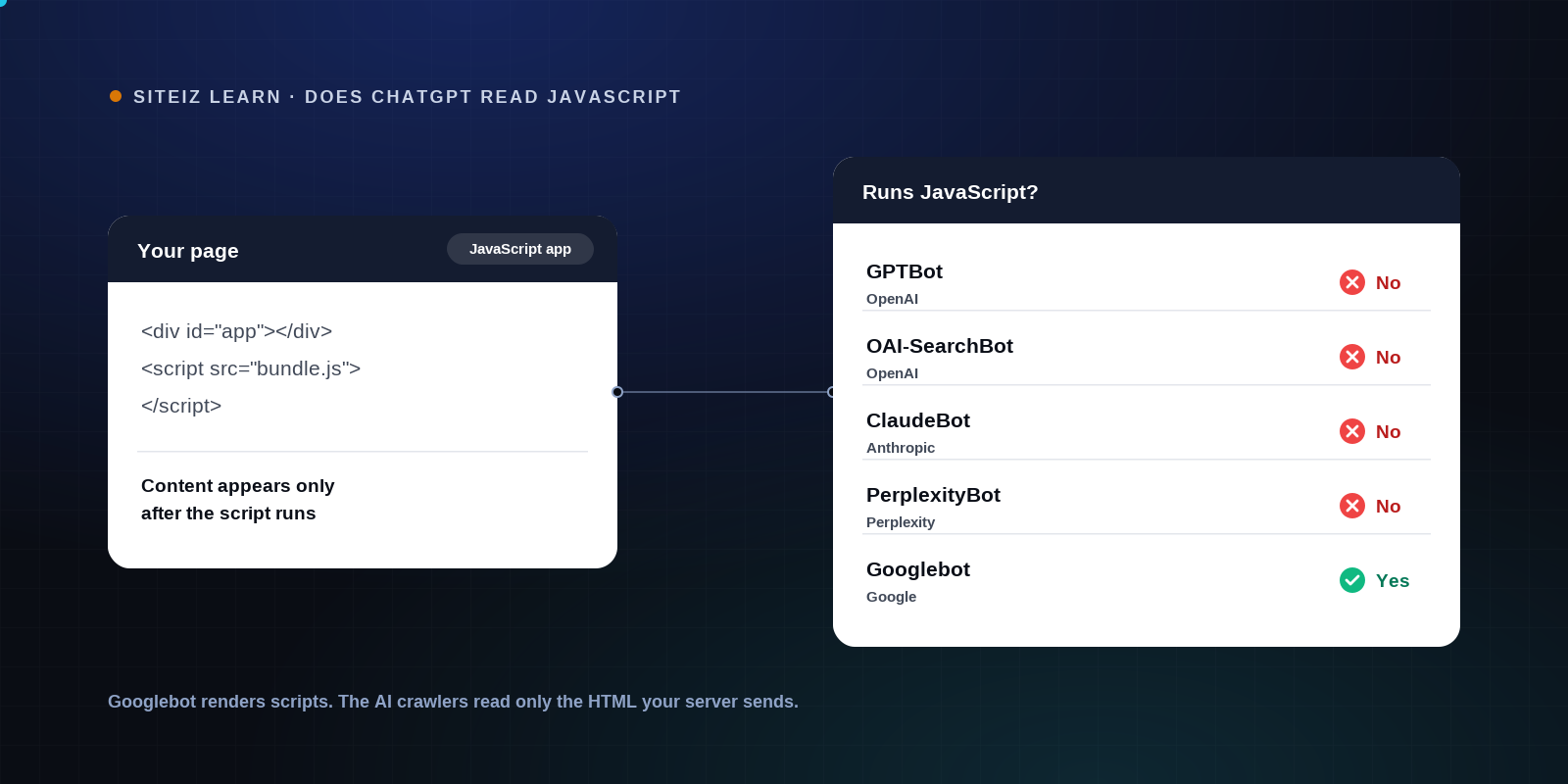
Most AI crawlers do not run JavaScript. They read the raw HTML the server sends. If text only appears after a script runs, those crawlers never see it.
Of the 70 homepages we could fully scan, most get this right. The median share of hidden text was 0%. But five deliver most of their homepage only through JavaScript.
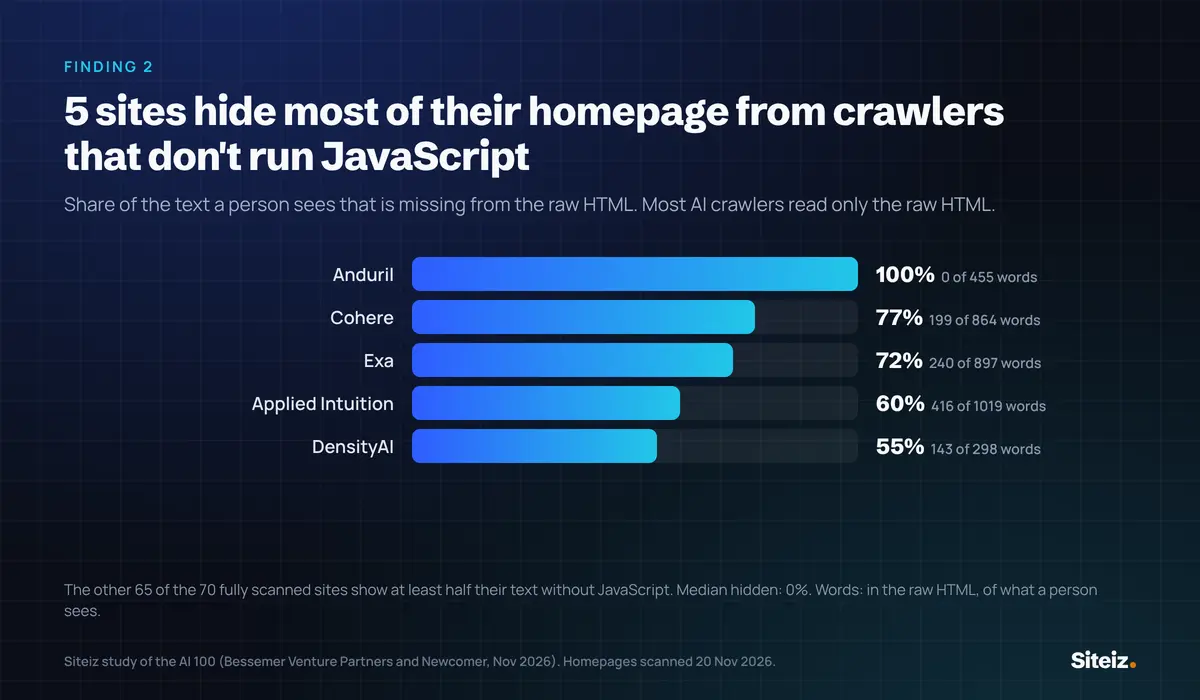
Anduril's homepage had no readable text at all in the raw HTML. A person sees 455 words. A crawler that doesn't run JavaScript sees none of them.
Exa is the other notable one. It sells web search built for AI agents, and 72% of its own homepage text is missing from the raw HTML.
Finding 4: half have an llms.txt, a fifth serve markdown
The AI 100 is far ahead of the average website on newer signals for AI.
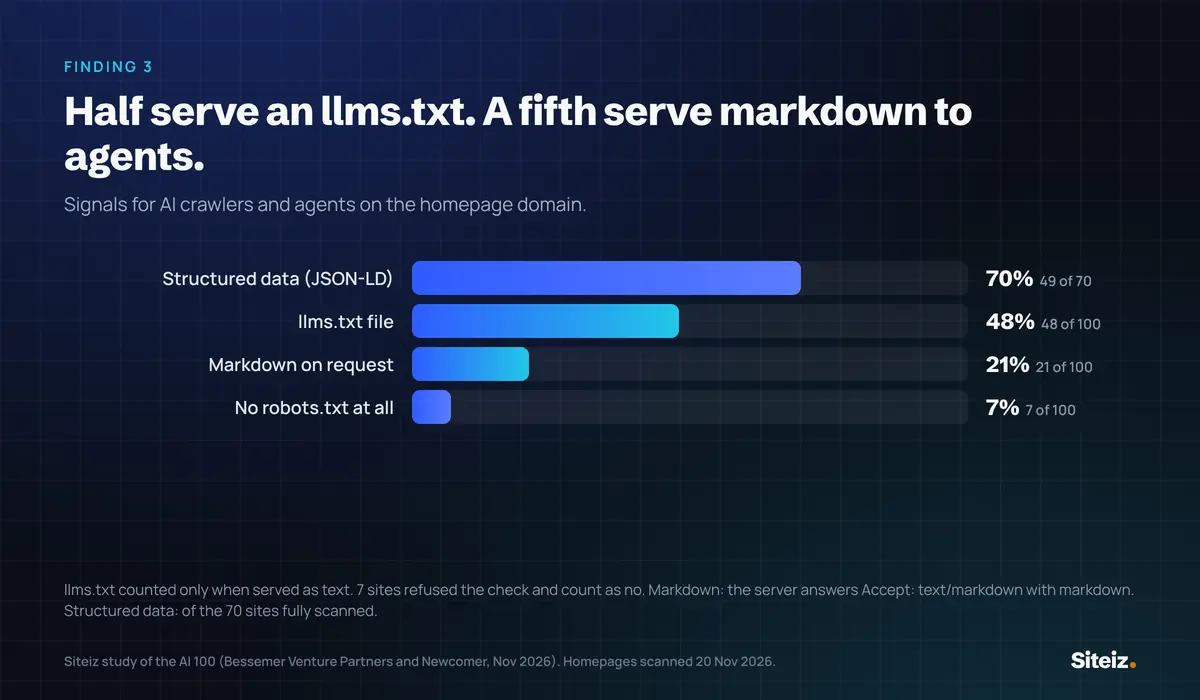
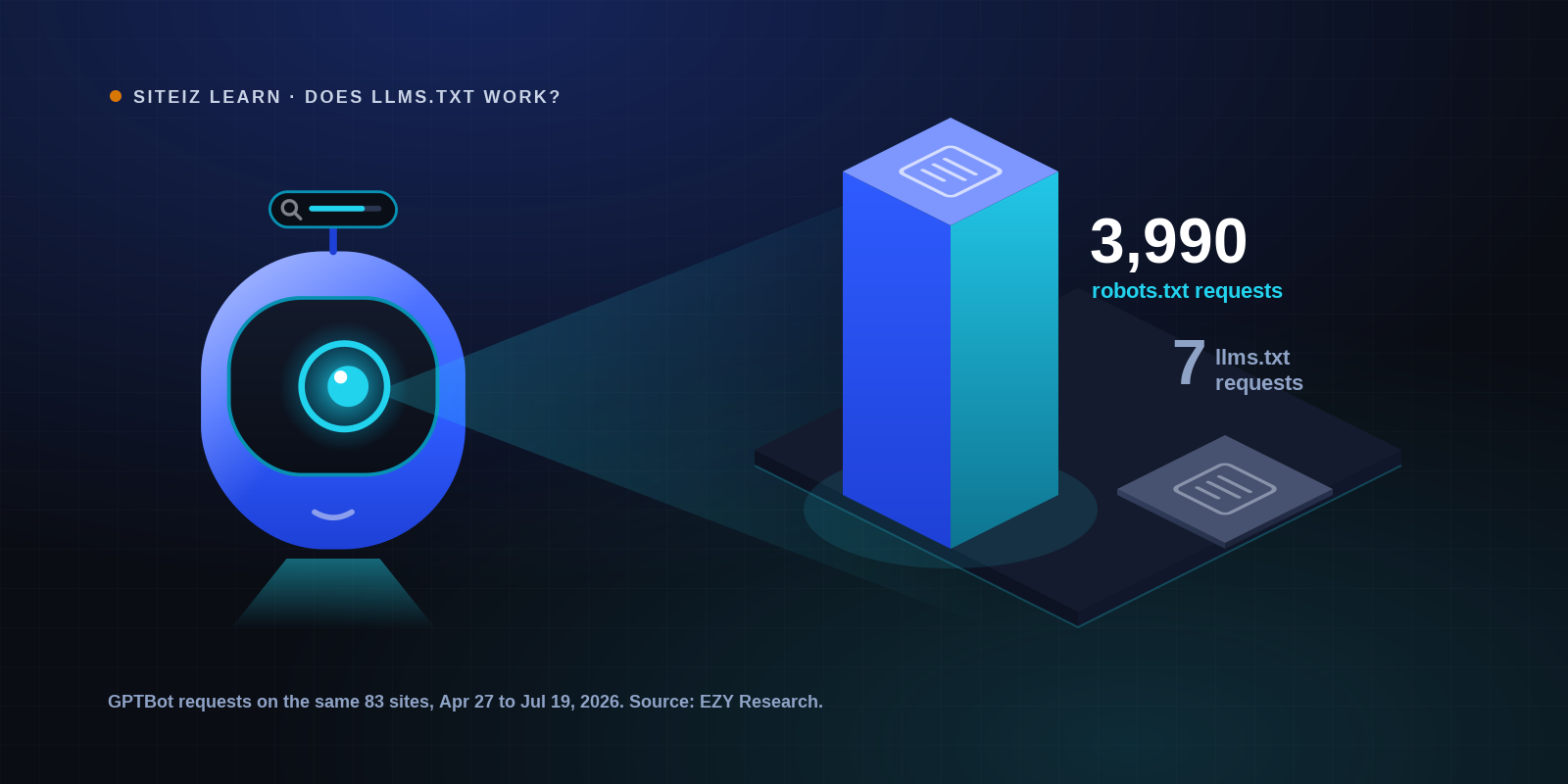
- llms.txt: 48 of 100 serve one, 45 don't, and 7 refused the check. Anthropic's homepage domain returns a 404 for it. Whether llms.txt helps at all is still debated; we looked at the evidence.
- Markdown for agents: 21 of 100 return a markdown version of the page when asked with
Accept: text/markdown. That saves an AI agent most of the tokens it would spend reading HTML. More on why markdown matters. - Structured data: 21 of the 70 fully scanned homepages have no JSON-LD at all, including Anthropic, OpenAI and Databricks. For a homepage, Organization markup is the simplest way to tell machines who you are.
Two sites send AI bots a different page. Databricks gives bots the same text but adds two extra JSON-LD blocks only for AI bot user agents. Exa sends PerplexityBot a fuller version of the page than a plain browser request gets, with an empty title and meta description, while GPTBot and ClaudeBot get the same thin version as everyone else. That looks like pre-rendering for one bot. Serving bots different content is a fine line; we explain where it sits in serving different content to AI bots.
The scores
Across the 70 homepages we could fully scan, the median Siteiz score was 82 out of 100. Ten got an A and one got an F.
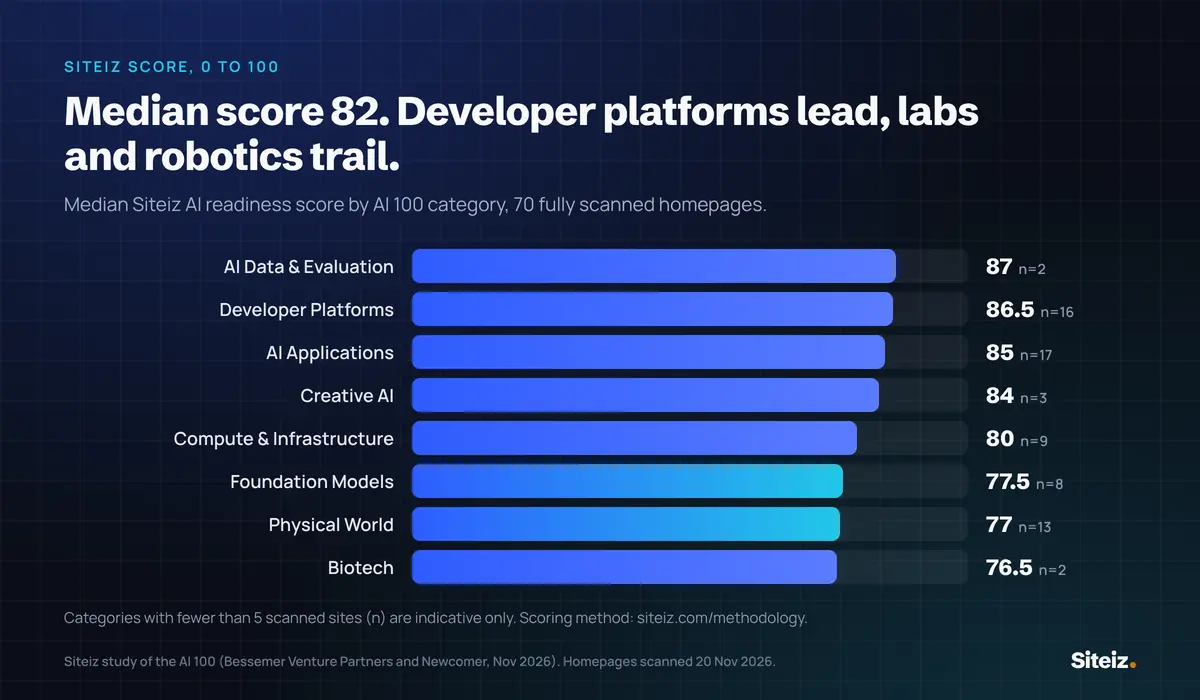
Developer platforms and AI applications scored highest, which fits: their buyers are developers and their sites are built to be read by tools. The highest scores went to Mercor (95), Parallel (94), and Cognition, Fal, Abridge and EvenUp (92 each).
The model labs and the robotics and defense companies scored lower, with medians of 77.5 and 77. Anduril had the lowest score, 47, mainly because its homepage text is invisible without JavaScript.
What it means for your website
Five checks, in this order:
- Fetch your homepage as an AI bot. Use each bot's user agent, not just a browser. If you get a challenge page or a 403, find out whether your CDN lets the verified crawler through.
- Check your bot protection settings. Most CDNs and bot protection tools let you allow verified crawlers by name. Decide which AI crawlers you want, on purpose, instead of leaving it to the default.
- Read your raw HTML. View source, or fetch the page without JavaScript. Your main text, headings and prices should be there.
- Add Organization structured data to your homepage, with your name, logo and links.
- Then robots.txt. Allow the AI search crawlers you want to be found by. Blocking training crawlers is a separate choice.
How we did it
- Sample: all 100 companies on the AI 100 by Bessemer Venture Partners and Newcomer, published 12 November 2026. We used the list, ranks, categories and homepage URLs exactly as published, without adding or removing anyone.
- Scan: the production Siteiz scanner, the same one behind the free scan, run on 20 November 2026 from one location in Sweden. Each homepage was fetched as SiteizBot without JavaScript, then in a real browser, then with the GPTBot, ClaudeBot and PerplexityBot user agents. robots.txt was evaluated for 11 AI crawlers at the homepage path.
- Two passes: every site was scanned once, then sites with a failed browser render or a block were scanned again with 20 seconds between sites. Every block in this article was seen in both passes.
- Denominators: robots.txt, llms.txt, markdown and blocks are counted over all 100 sites. Text, structured data and scores are counted over the 70 sites we could fully read: 12 blocked us, 1 returned an empty page, and 17 more could not be loaded in our browser in either pass.
- No estimates: every number is counted from the scan results. The scoring method is public.
Limits. We scanned homepages only, from one location, on one day. Our crawler is not a verified AI crawler, so firewall results show what an unverified crawler gets. Sites change, so this is a snapshot.
Data. The results for every company are in the study data (CSV), free to reuse with credit to Siteiz. The full dataset is archived on Zenodo: doi.org/10.5281/zenodo.24404666 (CC BY 4.0).
Sources
Free PDF
Get the full AI 100 study as a PDF
All findings, the charts and the results for every company on the list. We email you the download link.
FAQ
Common questions
Short answers to what people ask most about this topic.
Do the top AI companies block AI crawlers on their own websites?
Almost never in robots.txt. Only 1 of the 100 companies on the AI 100 list blocks AI search crawlers there, and 7 block AI training crawlers such as GPTBot or CCBot. The bigger barrier is the firewall. 12 of 100 homepages served our crawler a Cloudflare challenge, a Vercel Security Checkpoint or a DataDome page instead of the content.
Does a bot challenge mean ChatGPT or Perplexity can't read the site?
Not necessarily. Our crawler is not a verified AI crawler. Firewalls can recognise the real GPTBot or PerplexityBot by the servers they come from and let them through, while turning away anyone who only copies the name. What the result does show is that the page is not open to every crawler, and that only verified bots get in.
Which AI companies hide their homepage from crawlers that don't run JavaScript?
Of the 70 homepages we could fully scan, five deliver most of their text only after JavaScript runs. Anduril's homepage had no readable text in the raw HTML, Cohere was missing 77%, Exa 72%, Applied Intuition 60% and DensityAI 55%. Most AI crawlers read only the raw HTML, so that text is invisible to them.
How many AI companies have an llms.txt file?
48 of the 100 companies on the AI 100 list serve an llms.txt file on their homepage domain, far more than typical websites. 21 of 100 also return a markdown version of the page when a client asks for it with an Accept text/markdown header.