On this page
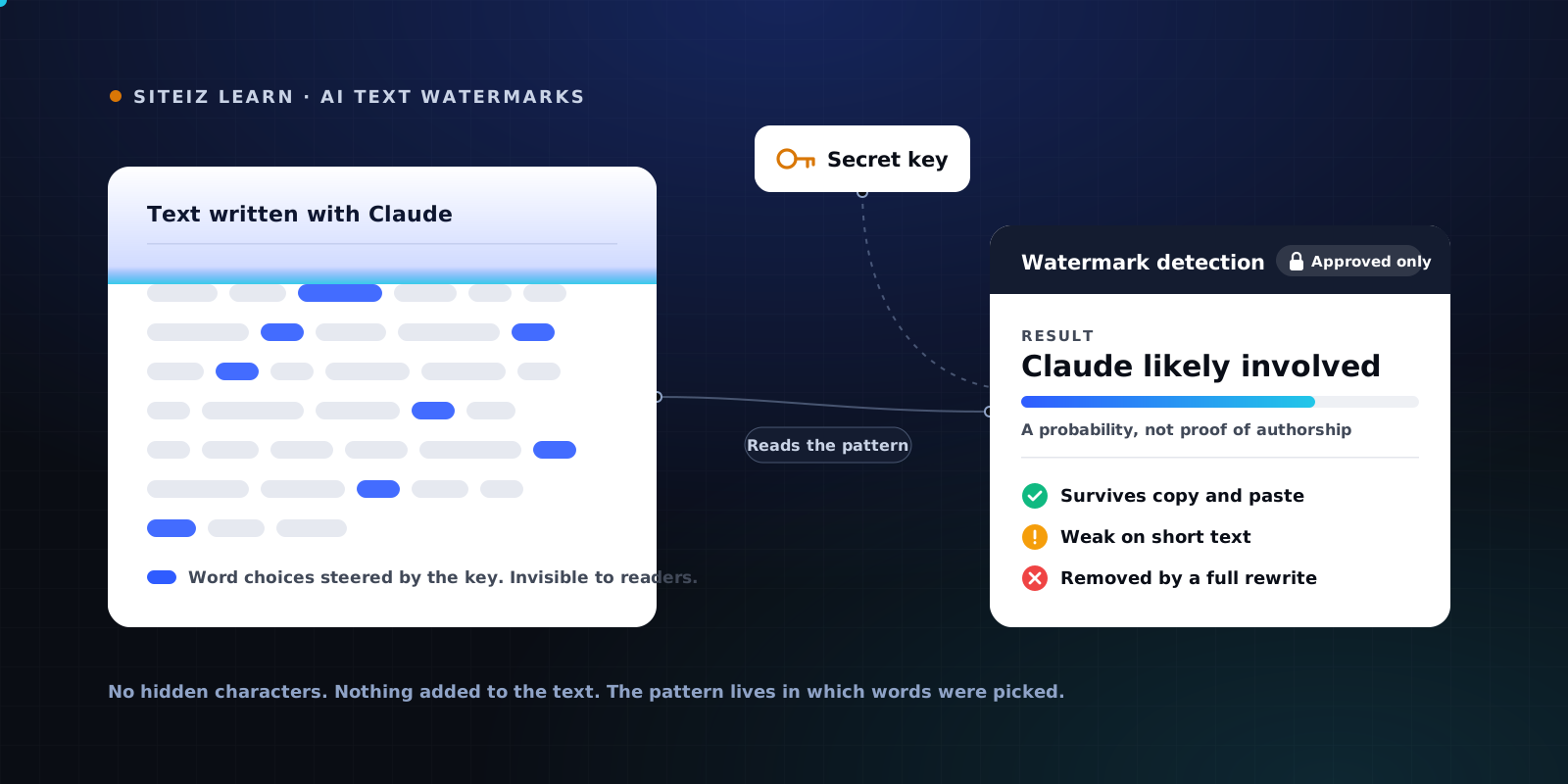
Yes. Since August 2026, Claude puts an invisible watermark in the text it writes. You cannot see it, and nothing is added to the words. The mark is in which words Claude chose.
If you publish content written or edited with Claude, here is what that means for your website, your search traffic and your legal obligations.
How the watermark works
When a language model writes, it often has several good next words to choose from. Normally a random number generator breaks the tie. Claude uses a secret key instead.
Every key-driven choice still reads naturally. Across a few hundred words, though, the choices form a pattern. Someone with the key can test for that pattern. Anyone else sees ordinary text.
Anthropic says the method is a version of SynthID-Text, which Google DeepMind published in Nature in 2024. Three things follow from that design:
- No hidden characters. Tools that strip invisible Unicode from text have nothing to strip.
- No quality change. Claude still picks a good word. The key only decides between equally good options.
- Weak where there is no choice. A fact, a sum or an exact line of code has one right answer, so there is little room for the pattern.
Images and files are handled differently. PNG, JPEG and SVG files that Claude makes carry a signed C2PA content credential in their metadata instead.
Which Claude models mark their text
Claude models launched on or after August 2, 2026 watermark text from launch. That date is when the EU AI Act's marking rules took effect. Anthropic is adding the watermark to older models over time, and it applies the mark worldwide, not only in the EU.
The mark is applied at the model level. It shows up whether the text comes from the Claude apps, Claude Code, the API or a cloud partner. Anthropic keeps the current list of models on its help page about marking.
What the watermark can and cannot tell
This is the part most coverage gets wrong. A detection result is a likelihood, not a verdict.
| What happened to the text | Mark still detectable? |
|---|---|
| Copied and pasted somewhere else | Yes |
| Lightly edited by a person | Usually |
| Translated by Claude | Yes, Claude chose every word |
| Proofread by Claude | Weak, only the corrections carry it |
| Short text, like a meta description or a headline | Unreliable |
| Mostly facts, numbers or code | Weak |
| Fully rewritten by a person or another tool | No |
| Written by ChatGPT, Gemini or another AI | No, it only detects Claude |
Two rules sum it up:
A detected mark means Claude was likely involved at some point. It cannot tell "written by Claude" from "edited by Claude". No mark proves nothing either way.
Who can check text today
As of October 2026, there is no public tool for checking text.
- The detection API is in private preview. Anthropic opened it to regulators, law enforcement, media, fact-checkers, independent researchers, educational organizations and EU civil society groups. Companies with their own compliance obligations can apply. Anthropic says it plans to widen access over time.
- The Claude Content Checker is free and public, but it only reads the C2PA credentials on files. It does not check pasted text.
- AI detectors like GPTZero or Originality.ai do not read the watermark. They guess from writing style, and that is a different method with its own error rates.
Anthropic has not announced a public text checker. One reason providers hold back: a free detector would let anyone test rewrites until the mark breaks. Google also keeps its SynthID Detector behind a waitlist.
What it means for your website
Search rankings
Google does not rank content lower for being AI-written. Its guidance on generative AI content targets something else: generating many pages without adding value for users, which falls under its scaled content abuse policy.
The watermark does not change that rule. It changes how easy AI use is to prove. A site with hundreds of thin, unreviewed pages is now easier to identify, by people and possibly by platforms later.
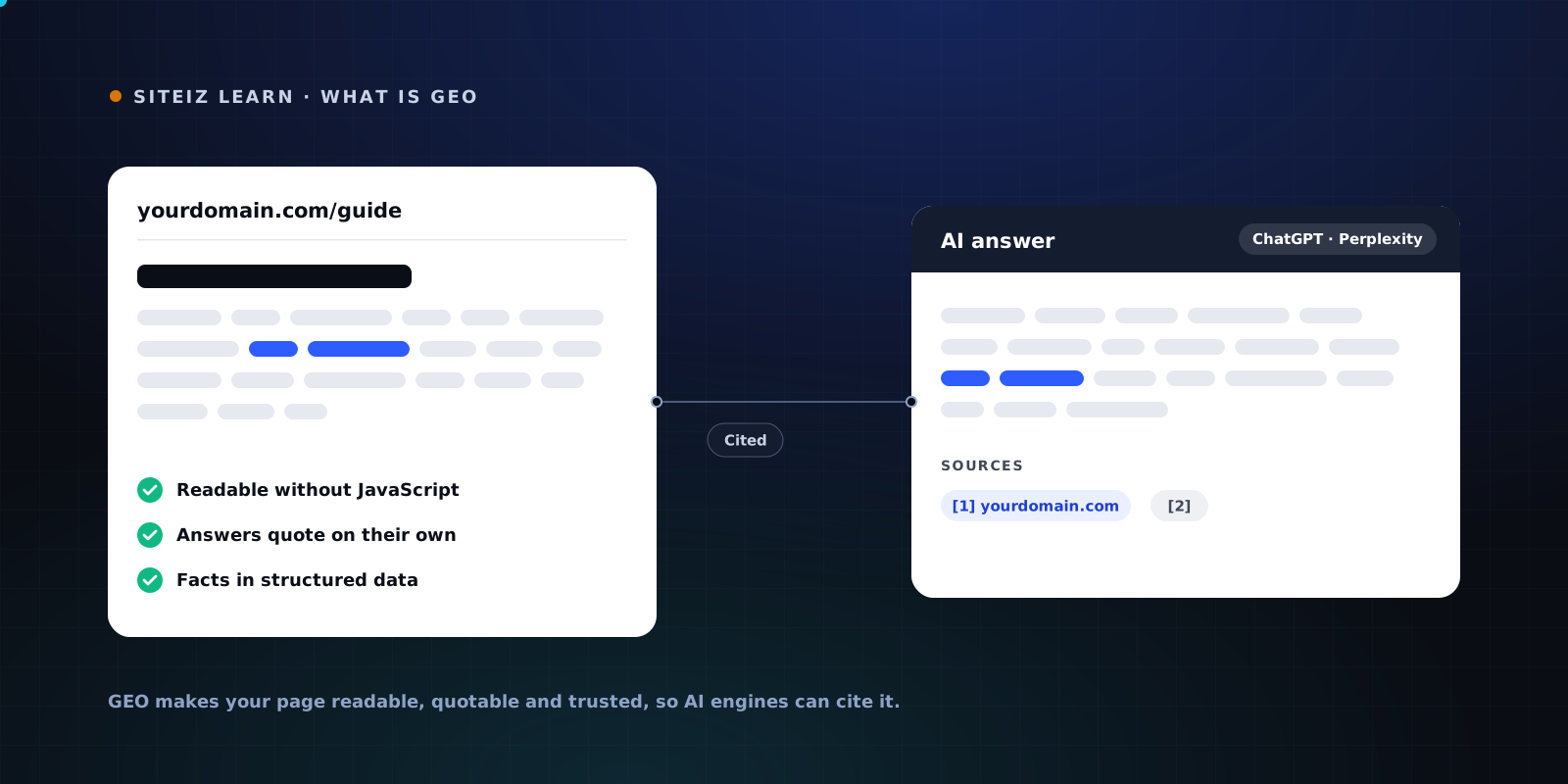
The same logic applies to AI search. ChatGPT, Perplexity and Google's AI features cite pages that answer a question clearly and correctly. Being AI-assisted is not the problem. Being generic is. Our guide to Generative Engine Optimization covers what gets a page cited.
The EU AI Act
Article 50 of the AI Act has applied since August 2, 2026. It splits the work in two:
- Providers like Anthropic must mark AI output in a machine-readable way. That is the watermark.
- Deployers, meaning whoever publishes, must disclose AI-generated text that is published to inform the public on matters of public interest.
The deployer rule has an exception. If the text went through human review or editorial control, and a person or organization holds editorial responsibility for it, no disclosure is required. Product pages and most marketing copy are unlikely to count as matters of public interest. News-style articles, health or finance explainers and policy content might. If you are unsure, ask a lawyer, because this guide is not legal advice.
Clients, freelancers and agencies
Media, universities and fact-checkers can now get access to a detector. If your contracts promise "human-written" content, check what that promise actually means. A writer who drafts with Claude and edits lightly will often still carry the mark.
A practical policy for AI-assisted content
- Put a person on every published page. One named owner who reads it, checks the facts and approves it. That covers both Google's guidance and the AI Act exception.
- Check every fact against a source. The watermark is weakest in facts, and so is the model. Facts are where errors hurt most.
- Add what only you know. Your data, your examples, your opinion. That is what makes a page worth citing, and it is the part no model can write for you.
- Disclose where it matters. For public-interest content, a short line about how AI was used is cheap insurance. Google also suggests telling readers how automation was used.
- Keep a simple record. Who reviewed what, and when. If anyone ever asks, you can answer in a minute.
Should you try to remove it?
No. A full rewrite removes the mark, but by then a person has done the work and the original problem is gone anyway. "Watermark remover" tools that strip invisible characters do nothing here, because Claude adds none.
Trying to hide AI use also creates the risk you wanted to avoid. A reviewed, useful page needs no disguise. An unreviewed page stays a weak page whether it carries the mark or not.
The watermark tells someone that Claude was likely involved. Whether AI search can read and cite your page is a separate question, and you can check that yourself. The scan methodology lists every check we run.
See how AI crawlers read your page with the free Siteiz scan.
Common questions
Does Claude add a watermark to the text it writes?
Yes. Anthropic announced in August 2026 that Claude models launched from August 2, 2026 watermark their text, and that older models are being added. The mark is a statistical pattern in which words Claude picks. Nothing visible or hidden is added to the text.
Can I check if a text was written by Claude?
Not with a public tool, as of October 2026. Anthropic's watermark detection API is in private preview for approved organizations such as regulators, media, fact-checkers and researchers. Anthropic's free Content Checker only reads the credentials attached to files like PNG and JPEG, not plain text.
Will Google penalize my website for using Claude?
Not for using it. Google's guidance targets pages generated at scale without adding value for users, whatever tool made them. Reviewed, accurate, useful content is fine. The watermark only makes AI use easier to show, so bulk pages nobody checked become a bigger risk.
Does editing remove the Claude watermark?
Light edits usually leave enough of the pattern to detect. A full rewrite that replaces the words removes it. Short texts, factual passages and code carry a weak signal to begin with, so detection there is unreliable.